Another successful season is almost over… can you believe it? It seems like just yesterday we were getting ready for the brewery opening in May! The last day for the season will be December 23rd, 2018. We will be open again in the spring (usually around the last week of April or first week of May), so keep your eyes peeled for that! Thank you all for such a wonderful 2018 season, including all the wonderful memories down in the brewery.
On a sadder note, this is my last blog post for the foreseeable future for the Growler. In case you missed my post in August, I am in the middle of my first year of a PhD program at the University of North Carolina at Chapel Hill. At the end of the summer, I sadly said goodbye to the Village and the historic brewery to move down to North Carolina to begin school at UNC. I have been continuing this blog in my absence, but with this post my queue schedule is now empty.
Thank you to all my wonderful coworkers (who are the easiest people in the world to bond with), Ed our former brewmaster and my best pal every weekend down in the brewery, and of course to all the visitors who challenged me with their questions and entertained me with their own personal stories and anecdotes about beer. I will never forget the couples who got married here and came down to visit, the guests who discovered a new type of beer that didn’t know they loved, and the regulars who would remember me and want to catch up like old friends. Who knows, maybe one day I will be back in the brewery once again!
And of course, a final thanks to all the readers! I hope you enjoyed my little posts about beer, delivered to you faithfully every Friday. I am not sure yet who may take the reigns of this blog, but i’m sure they will do a fantastic job.
Thank you all and have a very happy holidays!
Love all the way from beautiful Chapel Hill, North Carolina
Merry Christmas and Happy Holidays everyone! Can you believe Christmas is around the corner? If you’re organized and on top of everything, you definitely have your holiday shopping all taken care of. However, if you’re like me, you’re still looking for some last minute things! You’re in luck… the Black Creek Pioneer Village gift shop has some great choices for unique and fun gifts! As this is the Historic brewery blog, I’ve included some beer themed gifts as well! The gift shop closes at 4:30pm on weekdays, 5:00pm on weekends. Or, if you’re attending Christmas by Lamplight, the gift shop will be open late so you can pop in!
Artisan Christmas Ornaments and Decorations – Aren’t these beautiful? We have an amazing range of artisan ornaments, knick-knacks, and decorations available in the gift shop. If you’re looking for a beautiful ornament, or some nice things to place on the mantle, we have a variety of different things to choose from.
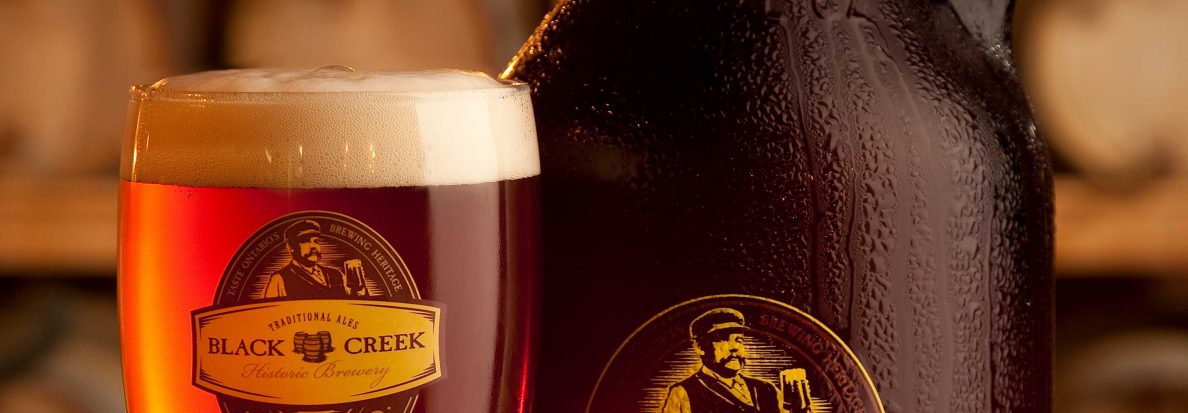
2L Refillable Growler Jug – Isn’t this cool? This is a refillable growler jug in two snazzy finishes. Each one holds 2 litres of beer, or any other liquid you may want to place in there. It’ll store a ton of beer from your favorite craft brewery, and even keep it cold and fresh if you want to transport it!
“Beer Snob” Growler Carrier – Okay so maybe you’re more of a fan of the traditional dark glass growlers over a refillable jug. No problem! This growler carrier can help you transport your heavy growler full of beer. This carrier comfortably fits a 2 liter growler, and securely holds it in place. Plus it is pretty stylish looking!
Black Creek Brewery Merchandise – As always, we have a ton of cool merchandise available to purchase. You can represent your love of our historic brewery and the village! We just got some beautiful new colors, including this pretty bright coral shade. We also have scarves and pom-pom hats to help you stay warm in this chilly weather.
Uncle Bob’s Ugly Sweater Beer Bottle Cozies – Do you love dressing ugly for the holidays? Then this beer cozy is for you! It comes in a variety of styles to charm any guests attending that ugly sweater party. Plus, it’ll keep your beer insulated and prevent that icky wet label feeling that sometimes happens with an ice cold beer.
Beer Jelly – If you caught our “beer in food” post from way back in October, you know exactly what beer jelly is! If not, i’ll recap: Beer Jelly is exactly what you would expect – a jelly with beer as the main ingredient. It’s great for cheese boards, breads, or a glaze on meat. Beer jelly is great because you get the essence of the beer and its taste without the bitterness of the hops. We have beer jelly available in a range of flavors in our gift shop, including pilsner, IPA, and wheat beer. If this sounds great to you, you’re in luck! We have a gift pack of beer jellies available for purchase in the gift shop!
Of course, this is not an extensive list of all the great things we have available in our gift shop! Come and see for yourself. The gift shop is open every day at 11:00am, and closes 30 minutes after Village closing time.
Merry Christmas everyone! Can you believe that the holiday season is already upon us? Family Christmas Weekends are in full swing, and Christmas by Lamplight begins tomorrow! In honor of all the Victorian Christmas cheer that will be abundant at the Village, i’m going to explore how the Victorians celebrated Christmas back in the 19th century, and how those traditions have lasted to this day.
My favorite part of Christmas at the village.. the food! Especially the flaming puddings.
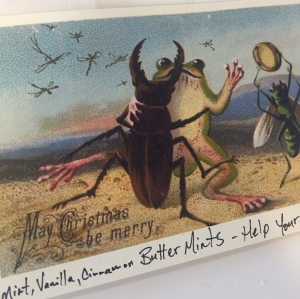
Did you know that many Christmas traditions that we enjoy today come from Victorian times? In fact, Christmas’ tradition as a huge holiday tradition originated in Victorian England. According to the BBC, many credit the adopting of these Christmas traditions with the marriage of Albert and Victoria. The German-born Albert’s childhood included a Christmas tree, complete with decorations and gifts. The Christmas Card was also introduced around this time, when children (including royal children) were encouraged to make their own cards and send them through the post to loved ones.
A Victorian Christmas card! Courtesy of a generous coworker who brought us treats last Christmas. A little different from what you expect from a Christmas card, but so charming!!
The Christmas dinner did not originate in Victorian Britain, but the roast turkey definitely did! The BBC states that the large size of the tradition Christmas turkey was appealing to families looking to feed a large brood for the holidays. Victorians also enjoyed nuts, mince pies, oranges, and of course, flaming puddings!
As is popular here at the village, Christmas became centered around the family. Gift giving, games, carols, and eating together became the tradition as Christmas became more and more popular. It became an excellent reason to celebrate time with family, and extend wishes and sentiments of good cheer and generosity. This is an attitude that still reflects to this day when talking about what makes Christmas important.
If you would like to partake in some Victorian Christmas traditions, we are running our Family Christmas Weekends every weekend until December 23rd, and Christmas by Lamplight on weekend evenings, also until the 23rd. The brewery will also be open on these weekends for tastings!
It’s that magical time of year! Christmas by Lamplight will be starting next weekend! Lamplight will be running every weekend starting on the 8th and ending on our last day of the season, December 23rd. Many guests look forward to this Victorian Christmas celebration every year, and make it a part of their own family’s holiday tradition. Why don’t you join us? Here is what you can expect from the Lamplight festivities:
A cozy table set especially for the Lamplight celebrations
See the Village at your own pace from 6:00 pm to 9:30 pm.
Enjoy the magical glow of lamps and lanterns, flickering candles and cozy fireplaces
Relax, wander and visit our many homes and workshops, decorated to celebrate the season
Stop awhile and enjoy traditional folk music, Christmas caroling and choirs
Join in the creation of seasonal ornaments or crafts to take home
Savour samples of festive foods
Peruse our gift shop for one-of-a-kind items handmade in the Village
We’re getting into the colder months – that means snow, chilly weather, and of course… soup and stew season! I enjoyed working at the village last winter. Walking to the brewery every morning was so enjoyable, especially when fresh snow had just fallen on the village and all the historic buildings. Coming into the Halfway House and seeing one of our interpreters baking fresh bread or apple cake always gave me such a cozy and happy feeling. I almost didn’t mind that I was wearing two layers of itchy stockings under my work pants. Days like this inspire me to come home after work and throw everything in my fridge into a stew.
The Halfway House in the wintertime
To celebrate the cozier, chillier season, I have made a beef stew inspired by our Rifleman’s Ration brown ale. Looking through stew recipes, I realized that our brown ale is perfect as an ingredient in a soup or stew recipe for a cold winter day.
Dark ales work very well in stews, and I knew our Rifleman’s Ration would be an especially welcome addition to a beef stew. This recipe is a take on this Irish Beef Stew recipe, changed a little bit. (I cut out the butter, sorry! I tend to gravitate toward making clean eating recipes but if you’d like to make this stew more rich, the original recipe includes it at the link)
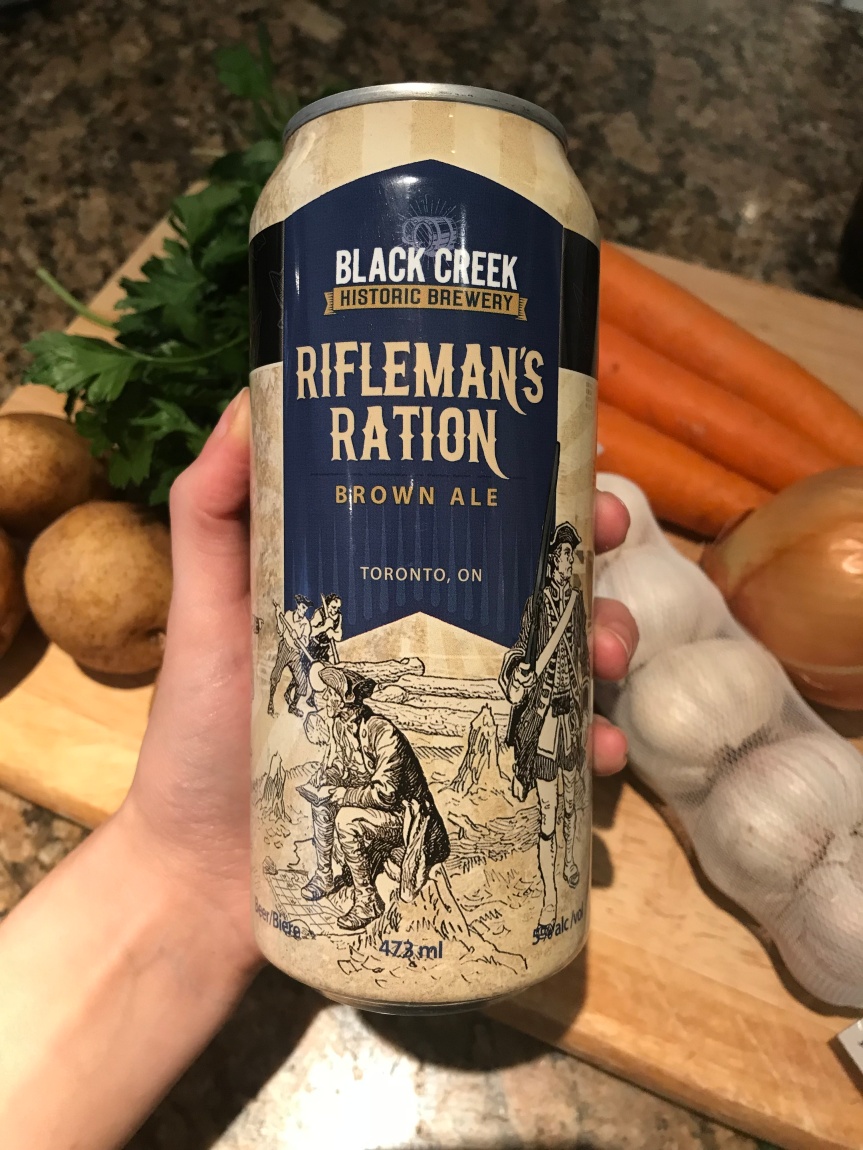
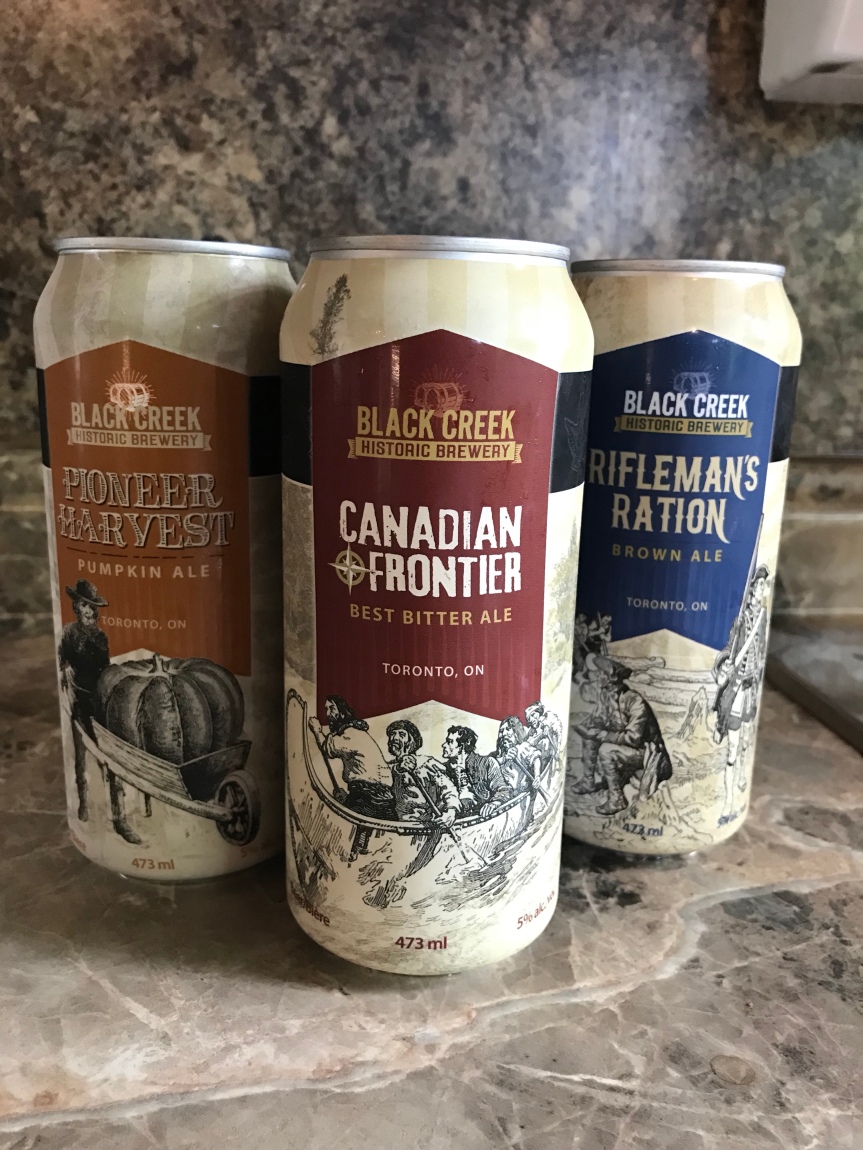
The star ingredient.. isn’t that just the prettiest tall can?
Of course, the star of this recipe is our rich and malty brown ale. The malty notes in our brown ale pair well with the beef and red wine to create a hearty stew that is perfect for the upcoming chilly weather!
Some ingredients used in the brown ale stew. The parsley is an especially nice touch.
Ingredients Needed: – 1 1/2 – 1 1/4 pound well marbled chuck beef stew meat, cut into generous cubes
– 1/4 cup olive oil for stew base, 3 tablespoons for veggies
– 6 large garlic cloves, minced
– 4 cups beef stock/broth
– 2 cups water
– 1 cup of Rifleman’s Ration brown ale (one can will do the job, with a little left over!)
– 1 cup of hearty red wine (I have no clue what a “hearty” red wine is, but I used cabernet sauvignon and it tasted great!)
– 2 tablespoons tomato paste
– 1 tablespoon dried thyme
– 1 tablespoon Worcestershire sauce
– 2 bay leaves
– 3 pounds russet potatoes, cut into 1/2 inch pieces (about 7 cups)
– 1 large onion, chopped
– salt, sugar, pepper, and fresh parsley to taste
1. Preparing the stew’s base – Heat the olive oil in a large (6 to 8 quart) pot over medium heat
– Sprinkle the beef pieces with salt, and begin browning in the pot. Add beef in batches, or the pot will be too crowded and the beef will not brown.
– When all the beef is browned, add all of it to the stewing pot. Add your garlic to the beef and sauté for 30 seconds.
– Add the beef stock, water, Rifleman’s Ration brown ale, red wine, tomato paste, thyme, Worcestershire sauce, and bay leaves. The original recipe also calls for 1 tablespoon of sugar, but I held the sugar and preferred the slight bitter richness in the stew’s body.
– Stir to combine and bring to a rolling boil. Then, reduce heat to low, cover, and simmer for 1 hour, stirring occasionally.
2. Prepare the veggies – While the beef and stock are simmering, heat 3 tablespoons of olive oil and add chopped carrots and onions
– Sauté until fragrant, and onions are golden
– Set aside until stock has simmered for 1 hour
3. Combine – Add the onion and carrot mix and the potatoes to the stew
– Add black pepper and salt, to taste
– Simmer until beef and veggies are soft. I simmered for about 45 mintues
– When finished, discard bay leaves and garnish with fresh parsley. Add more salt and pepper to taste
The end result was really tasty! The malty, slightly sweet notes of the Rifleman’s Ration paired well with the beef and red wine. I highly recommend this recipe, especially for any upcoming snow days! It kept very well, and I was eating it all week!
It’s never too early to begin celebrating Christmas! Starting this weekend, we will be holding our Family Christmas weekends, every Saturday and Sunday from now until December 23rd. It’s a great way to see the Village all dressed up for the season, and participate in some fun Victorian holiday traditions. So how will the Village be celebrating this year?
Come see the Village dressed up in its Christmas best!
Sing along to traditional Victorian Christmas carols
Trim a Christmas tree
See a history actors’ performance about Christmases past
Enjoy roasted chestnuts, mincemeat tarts, apple cider, and flaming puddings
Listen to Christmas tunes played live by our talented interpreters
Experience a horse drawn wagon ride
Browse our gift shop for artisan Christmas ornaments and pieces
This week’s blog post is coming to you a day early, because this is a throwback Thursday post! I did a similar throwback post to celebrate Doors Open 2018, but we have so many great photos in our photo archives that I just had to share a few more. This time, it’ll be all about the home of our Historic brewery – the Halfway House!
The Halfway House before its move and restoration. This photo really makes you appreciate how much restoration work went into restoring it into its current glory. Look at that roof! Judging by that particular Coca-Cola logo, this photo was likely taken sometime in the 1940s.
Halfway, almost unrecognizable, at its old location at Kingston Road and Midland Avenue in Scarborough.
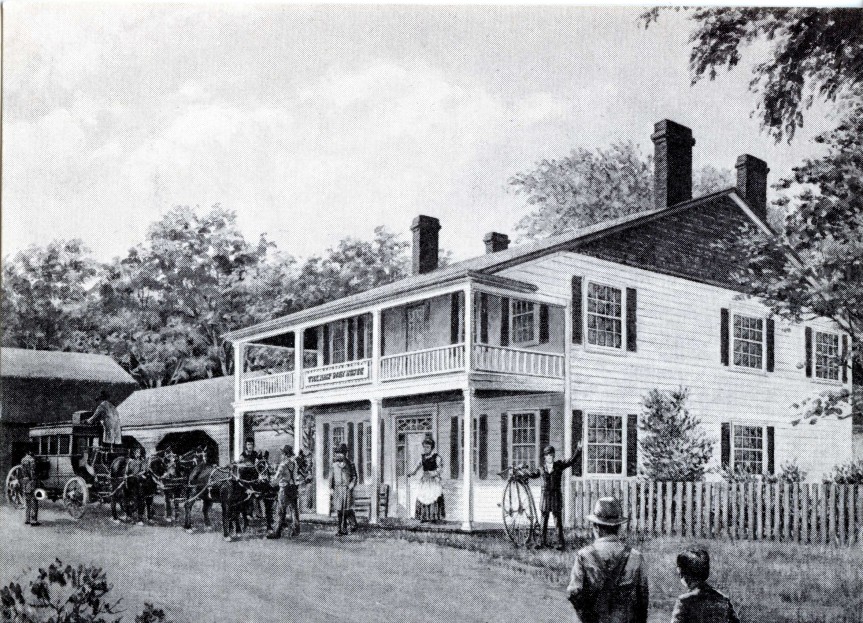
An artist’s depiction of how the Halfway House may have looked during Victorian times. The Halfway House was a rest spot on the stagecoach line, so it would have likely been bustling with travelers and guests.
Another artist’s depiction of how Halfway may have looked at the time. I really like this one because it’s done in color!
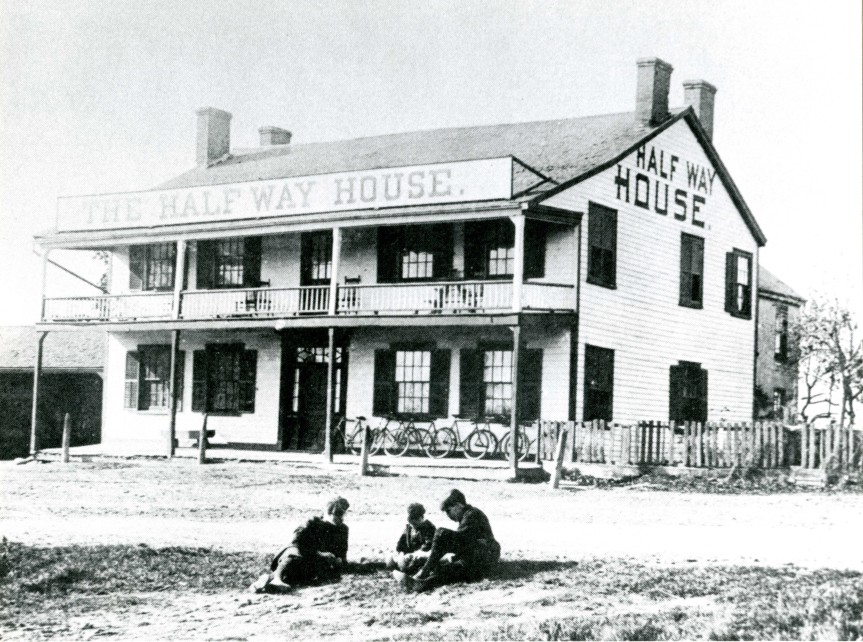
This photo is one of my favorites! I used it in the Doors Open post, but it’s too cool not to share again. I love the bicycles lined up on the Halfway House porch!
As you can see, the Halfway House has had a rich and interesting history before ending up here at Black Creek Pioneer Village.
I love seeing people’s reactions in the brewery when they learn something new. Something that surprises people the most is the different way beer was consumed in the 19th century as compared to today. When people hear that beer was consumed by many throughout the entire day and by children no less, they are very surprised. However, this wouldn’t have been a strong, alcoholic beer. It would have most likely been something called a small or table beer – a beer ranging anywhere from 0.5-2.8% ABV.
In comparison, our beers are about 5% ABV
Children, servants, and workers engaging in heavy physical labor are the last people you would want intoxicated on a regular basis. Table beer served the purpose of quenching thirst and providing nutrients, with an ABV as low as 0.5%. For comparison, the Canadian government classifies an alcoholic beverage as any drink containing more than 1.1% ABV. Table beer provided an enjoyable, nutritious, and calorie-dense alternative to water.
Table beer was usually made with the spent grains of a stronger brew. Not only was re-using the spent grains very economical (Victorians did not like to waste anything!) but created that weaker beer that was ideal for more regular consumption. A farmer drinking multiple pints of beer during a difficult workday is most likely not looking to get intoxicated, so a beer that comes in at 1% would be a perfect choice.
When we think of beer now, we associate it with social drinking, and potential intoxication. It is easy to forget that beer was used for more practical purposes in the 19th century. Table beer is a great example of that. Of course, table beer has lost its practical purpose in a day and age where we can easily access clean water and get a balanced meal at the grocery store. However, it’s still a great example of the changing attitudes and purpose of beer between the Victorian era and modern times.
Happy almost Halloween everybody! Perhaps you’ve been counting down the days, getting ready to enjoy the creepy and fun things the season has to offer. Well, you’re not alone. The Victorians also enjoyed the creepiness of Halloween! Folks in Victorian times seemed to live spooky lives year round – hair lockets, post-mortem photography, and mourning art dedicated to those who had passed away. However, they also celebrated Halloween, but not quite how we celebrate today. In honor of Halloween being just around the corner, let’s take a look at some Victorian traditions –
A Victorian Halloween greeting card
1. Halloween Parties The Victorians enjoyed a good Halloween party just as much as we do! Jack-O-Lanterns, ghost stories, games and spooky decorations were commonplace at these parties. According to the 1903 edition of the Sunday Herald of Syracuse, New York (originally researched and described by Stephanie Carroll):
Cushions were strewn about the floor for the guests in the library. When the green flames flickered out, someone lit the fireplace, and attendees began telling ghost stories. Each guest had been instructed to bring a ghost story or be “threatened with violent ejection.” The author commented that the stories were so frightening more than one person screamed when an alarm clock went off in the middle of it. He also commented that it was surprising how many guests had brought alarm clocks for this purpose. After the stories had ended, electric lights flickered on to reveal popping corn, games, and refreshments.
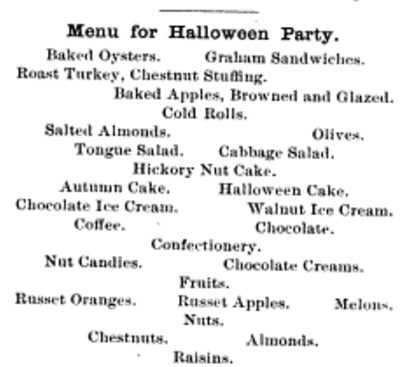
2. Halloween Treats No, the Victorians were not eating mini chocolate bars and stale bags of snack sized chips. Instead, they would indulge in treats such as cakes, fruit, nuts, apples, and of course ale! Victorians also had their version of candy apples, dipped in syrup and butter. Check out this recommendation for food to serve at a Halloween party:
Menu for a Halloween Party, Ingalls Home and Art Magazine, 1891. Courtesy Mimi Matthews
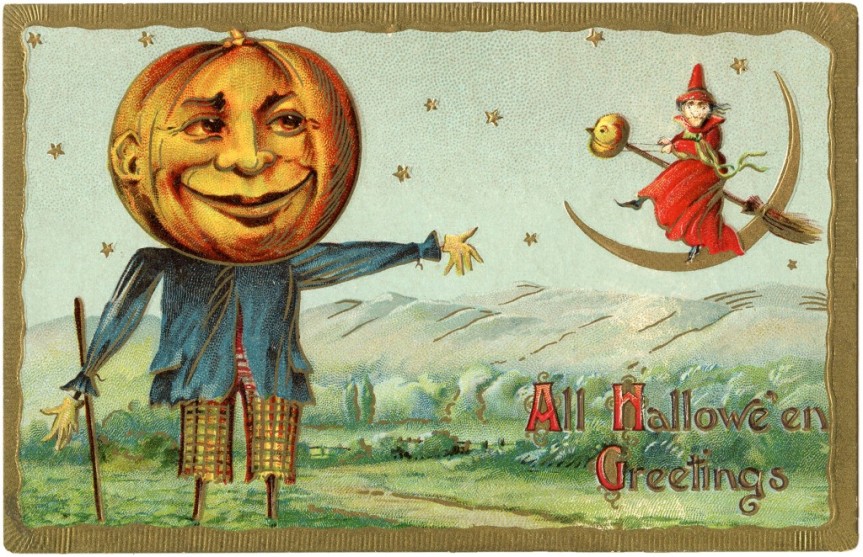
3. Halloween Postcards This is an interesting one. Victorians were the pioneers of the postcard, which usually featured an interesting piece of art on the front, and a space to write a message on the back. Victorians had an intricate post card for almost every occasion, including Christmas and Valentine’s day. Some of the artwork was a little odd… but that just made it all the more charming!
Happy Halloween! A nice postcard
In case that wasn’t enough Halloween for you, our Howling Hootenanny event will be running this weekend! Don’t miss the creepy creature show, the haunted maze, or the spooky pioneer superstitions!
Happy fall! The leaves are changing, the air is getting cool, and Halloween is just around the corner! That can only mean one thing, our Howling Hootenanny event is almost here! On October 20th and 21st, and the 27th and the 28th, we will have having a fun Halloween themed event especially for kids!
A vintage Victorian Halloween postcard! Courtesy the Virtual Victorian
So what will be going on during this howling good time?
Be amazed at exciting performances on the main stage (11:30 a.m., 1:00 p.m. and 2:30 p.m.)
Get up close and personal at the Creepy Creature Meet & Greet (12:00 p.m. – 4:00 p.m.)
Dare yourself to enter the Haunted Maze (12:00 p.m. – 4:00 p.m.)
Trick-or-Treat around the Village!
Try your hand at the Apple Sling Shot (12:00 p.m. – 4:00 p.m.) *Weather Permitting

 Artisan Christmas Ornaments and Decorations – Aren’t these beautiful? We have an amazing range of artisan ornaments, knick-knacks, and decorations available in the gift shop. If you’re looking for a beautiful ornament, or some nice things to place on the mantle, we have a variety of different things to choose from.
 2L Refillable Growler Jug – Isn’t this cool? This is a refillable growler jug in two snazzy finishes. Each one holds 2 litres of beer, or any other liquid you may want to place in there. It’ll store a ton of beer from your favorite craft brewery, and even keep it cold and fresh if you want to transport it!
 “Beer Snob” Growler Carrier – Okay so maybe you’re more of a fan of the traditional dark glass growlers over a refillable jug. No problem! This growler carrier can help you transport your heavy growler full of beer. This carrier comfortably fits a 2 liter growler, and securely holds it in place. Plus it is pretty stylish looking!
 Black Creek Brewery Merchandise – As always, we have a ton of cool merchandise available to purchase. You can represent your love of our historic brewery and the village! We just got some beautiful new colors, including this pretty bright coral shade. We also have scarves and pom-pom hats to help you stay warm in this chilly weather.
 Beer Jelly – If you caught our “beer in food” post from way back in October, you know exactly what beer jelly is! If not, i’ll recap: Beer Jelly is exactly what you would expect – a jelly with beer as the main ingredient. It’s great for cheese boards, breads, or a glaze on meat. Beer jelly is great because you get the essence of the beer and its taste without the bitterness of the hops. We have beer jelly available in a range of flavors in our gift shop, including pilsner, IPA, and wheat beer. If this sounds great to you, you’re in luck! We have a gift pack of beer jellies available for purchase in the gift shop!




 The Halfway House before its move and restoration. This photo really makes you appreciate how much restoration work went into restoring it into its current glory. Look at that roof! Judging by that particular Coca-Cola logo, this photo was likely taken sometime in the 1940s.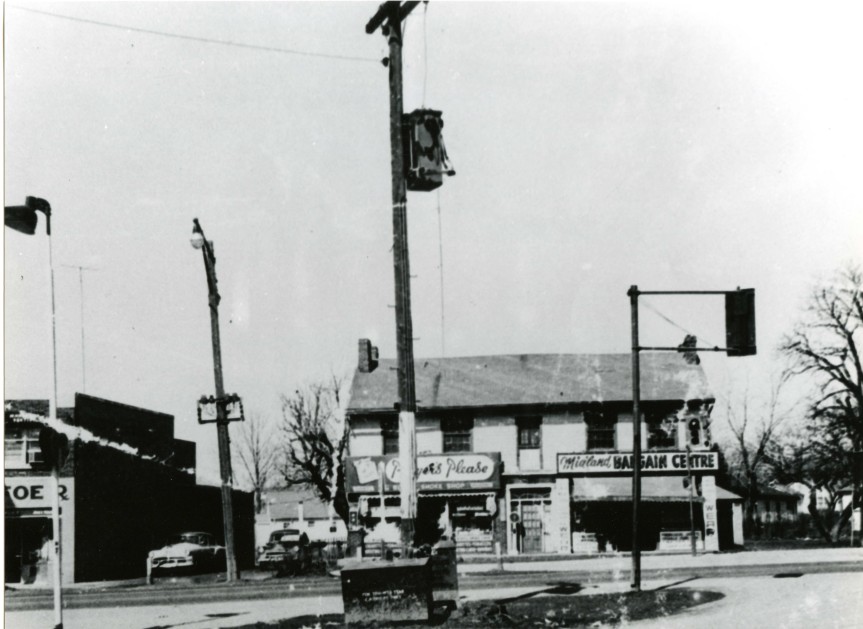



 The Black Creek Growler